
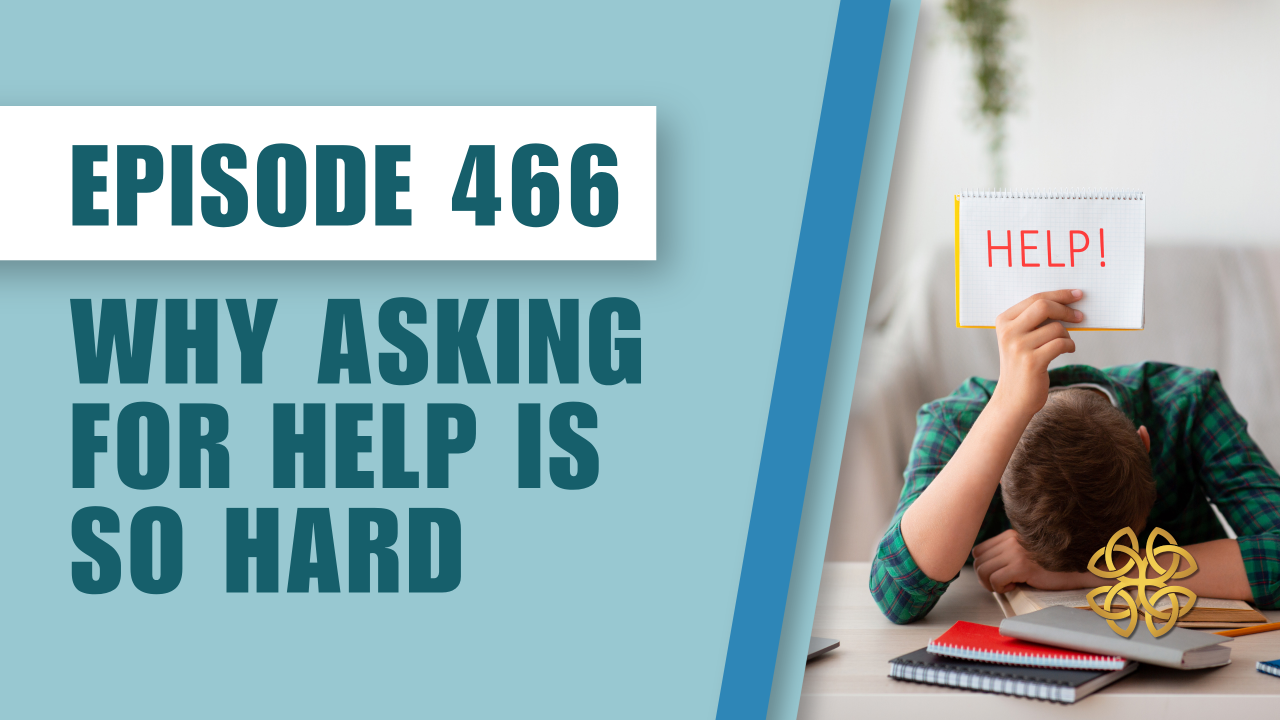
466: Why Asking for Help is So Hard
Jun 18, 2026Why Asking for Help Might Be the Missing Piece in Your Running (and Your Life)
When was the last time you needed help but didn’t ask for it?
Maybe you had a nagging ache that kept getting worse, but you convinced yourself it would go away if you just stretched a little more.
Maybe your training wasn’t clicking, but instead of reaching out to someone, you spent hours scrolling Google, YouTube, or ChatGPT hoping to find the magic answer.
Or maybe someone in your life was perfectly capable of helping you, and you still stayed quiet.
Welcome to our house this past week.
Kevin hurt his back during a strength workout. He’s experienced, disciplined, and incredibly resilient, so his instinct was to push through and figure it out himself. When he came in from the garage, I asked if he wanted my help, and he basically said no.
I’m a physical therapist with twenty years of experience helping people recover from injuries, but I didn’t jump in because he didn’t ask for my help.
A week has gone by, and he’s been in pain, has missed runs, and has been very frustrated.
So finally I asked him, one week later, “Why haven’t you asked for my help?”
He told me that he thought I would offer to help him when I saw him in pain.
But he never actually asked.
I know this all too well because I also struggle to ask for help when I could use it.
So why do we do this to ourselves? Why is it so hard to ask for help?
Why capable people struggle to ask for help
The runners I work with are some of the most determined people I know. They’re self-motivated, consistent, and willing to do hard things. Those qualities help them cross finish lines, but they can also become obstacles.
Many of us believe we should be able to solve our own problems. We don’t want to inconvenience anyone else. We don’t want to look weak or incapable. We tell ourselves, “I just need to work harder,” or “I’ll figure it out eventually.”
The irony is that the same grit that helps you finish a marathon can keep you stuck with an injury or plateau for months.
Sometimes perseverance isn’t the answer. Sometimes the bravest thing you can do is raise your hand and say, “I need some help.”
The hidden cost of staying silent
When we avoid asking for help, we often think we’re protecting ourselves or protecting other people.
But there’s a cost.
For Kevin, that cost was a week of pain and lost training. It affected his sleep, his mood, and even simple tasks like getting dressed or brushing his teeth.
For me, the cost was watching someone I love struggle while feeling like I couldn’t step in until he invited my help.
For runners, this pattern shows up all the time. You ignore the little ache until it becomes an injury. You keep repeating the same training mistakes instead of getting guidance. You stay on the plateau because you assume you just need to work harder.
The longer you wait, the bigger the problem becomes.
Why we convince ourselves we don’t need support
Over the years, I’ve noticed a few common stories we tell ourselves.
“I don’t want to be a burden.”
“I should know how to handle this by now.”
“If I ask for help, it means I’ve failed.”
“I can just find the answer online.”
The problem is that information isn’t the same thing as wisdom.
We have more access to knowledge than ever before, yet so many runners are more confused than ever. Social media, search engines, and AI can all provide ideas, but they can’t replace context, experience, or the ability to apply knowledge to your unique situation.
That’s where real coaching, real expertise, and real conversations matter.
How do you know it’s time to ask?
True, you don’t need help for every little thing that pops up, but there are signs that trying to figure it out alone isn’t working anymore.
Here are a few:
If you’ve been dealing with the same issue for a couple of weeks without improvement, it’s worth getting another perspective.
If your problem is affecting multiple parts of your life like your sleep, your mood, your relationships, or your consistency, it deserves attention.
If you’ve tried all the obvious solutions and still aren’t making progress, that’s often a signal that you’re missing something you can’t see on your own.
And if you’re avoiding dealing with the issue altogether because it feels overwhelming, that avoidance is often the clearest sign that it’s time to reach out.
Not all help is created equal
One of the biggest mistakes I see runners make is asking the wrong person.
A fast runner isn’t automatically a great coach. Someone with visible abs isn’t automatically a nutrition expert. A viral social media account doesn’t guarantee credibility.
Look for people who combine education, experience, and the ability to apply what they know to real humans with real lives.
And remember that sometimes the right help isn’t technical at all. Sometimes it’s your spouse, your training partner, or a trusted friend who simply listens and helps you see what you’ve been missing.
Asking for help isn’t weakness—it’s wisdom
Looking back, Kevin and I both learned something from this experience.
He realized that waiting until things got unbearable only delayed his recovery.
I realized that sometimes the people we love need a little more direct support than we think they do.
Most importantly, we were reminded that independence and humility can coexist.
You can be strong and still need guidance.
You can be capable and still ask questions.
You can be experienced and still benefit from another perspective.
In fact, the runners who make the most consistent progress aren’t the ones who always have the answers.
They’re the ones who know when to stop trying to do it all alone.
So if there’s something you’ve been carrying by yoursel, like a persistent injury, a frustrating plateau, or a challenge that keeps following you from run to run, consider this your reminder:
You don’t have to figure it out alone. And asking for help might be the very thing that helps you move forward.
If you want help from a 20 year physical therapist and running coach, check out the Running Reconnected Team:
https://www.realliferunners.com/team
It’s the place we can support you, both physically and mentally, to help you become the strong runner you want to be.
Enter your email address to get weekly episodes delivered to your inbox plus tips on how to become a physically and mentally stronger runner!
Don't worry, we won't blow up your inbox. We just want to send you some great info to help you in your running journey. We hate SPAM, and we will never sell your information, for any reason.
