
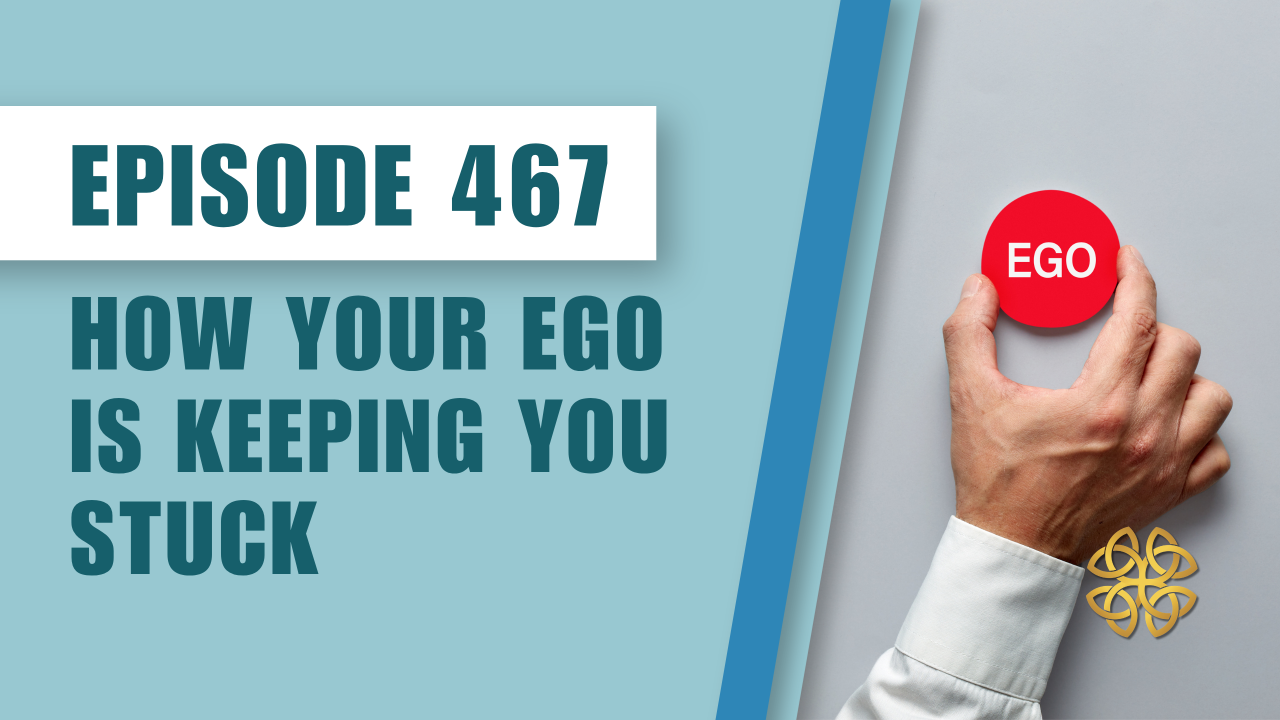
467: How Your Ego Is Keeping You Stuck
Jun 25, 2026Have you ever caught yourself saying, “I’m just not ready yet,” or “I should be able to figure this out on my own”?
Maybe you’ve hesitated to sign up for a race because you were afraid of finishing slower than you hoped. Maybe you’ve resisted hiring a coach because you didn’t want to admit you needed help. Or maybe you’ve been running every easy run a little too fast because slowing down feels like falling behind.
If any of that sounds familiar, you’re not alone, and it what’s behind it might not be what you think.
Lately, Kevin and I have been talking a lot about asking for help, especially after he spent a week dealing with back pain that forced him to change his routine. Those conversations led us to a bigger realization: underneath so many of the struggles we face is something we don’t often talk about — the ego.
Now, when I say ego, it probably isn’t what you might be thinking. This isn’t about arrogance, self-importance, or narcissism.
The kind of ego I’m talking about is much quieter. It’s the part of us that wants to protect our identity, avoid embarrassment, and stay safely inside our comfort zone.
While that instinct is completely human, it can also keep us stuck.
Ego Doesn't Always Look Like Confidence
When most people hear the word “ego,” they picture someone bragging about their accomplishments or believing they’re better than everyone else.
In reality, ego is the master of disguise. Arrogance is one of the disguises, but there are so many more common ones that affect every single one of us.
If you’re a human, you have an ego. But the way it presents looks different for everyone.
It can sound like independence: “I don’t need anyone’s help.”
It can hide behind caution: “Maybe I’ll wait until I’m fitter before I sign up.”
It can look like perfectionism: “I can’t run this race because I’ve missed days on my training plan.”
Sometimes it even masquerades as humility when we convince ourselves we shouldn’t put ourselves out there.
At its core, ego is trying to keep us safe. It wants to protect our reputation and the story we tell ourselves about who we are.
The problem is that growth requires vulnerability. It requires trying things we might not be good at yet.
The First Way Ego Holds You Back: It Stops You From Starting
One of the biggest ways ego shows up is by preventing action altogether.
You tell yourself you’ll register for the race after one more good training cycle. You’ll join the running group once you’re faster. You’ll start strength training when life gets less busy.
But “later” has a funny way of becoming never.
Often, the real fear isn’t that we can’t do it. It’s that we might fail publicly or discover we’re not as capable as we hoped.
The truth is that every experienced runner was once a beginner. Every marathoner once questioned whether they could finish a 5K. Waiting until you feel completely ready usually means waiting forever.
The Second Way Ego Holds You Back: It Stops You From Succeeding
Even after you get started, ego can quietly sabotage your progress.
I see this all the time with runners who struggle to follow their training plan because they feel the need to prove something. Easy runs become moderate runs. Recovery days become opportunities to squeeze out a few extra miles. Every workout turns into a test instead of purposeful practice.
The same thing happens when runners refuse to adjust their approach because “this is how I’ve always trained.”
Our bodies change. Our schedules change. Our stress levels change. What worked five or ten years ago may not be what serves us today.
Adapting isn’t giving up. It’s being wise enough to work with the body and life you have now instead of chasing the version of yourself that existed in a different season.
The Third Way Ego Holds You Back: It Stops You From Learning
This might be the sneakiest one of all.
Learning requires admitting that we don’t already know everything.
That can be uncomfortable.
Maybe your coach suggests slowing down your easy pace, adding more recovery, or changing your fueling strategy. Maybe you have a disappointing race and immediately start making excuses instead of asking what you can learn from the experience.
When our identity is wrapped up in being knowledgeable or successful, feedback can feel like criticism instead of an opportunity.
But the runners who continue improving year after year are rarely the ones who think they have all the answers. They’re the ones who stay curious.
Comparison Makes Ego Even Louder
Modern runners have endless opportunities to compare themselves with others.
A quick scroll through social media or your favorite training app can make it seem like everyone else is running farther, faster, or more consistently than you are.
The comparison game rarely motivates us in a healthy way. More often, it pressures us into training that doesn’t match our own goals or current abilities.
Your journey is yours and yours alone.
The pace that challenges someone else may be inappropriate for you. The mileage that fits another runner’s life might leave you exhausted and injured.
Progress comes from following your path, not someone else’s highlight reel.
One of the biggest lessons Kevin recently experienced had nothing to do with running.
After dealing with back pain, he had to relearn how to perform a basic squat with proper form. It would have been easy to rely on old habits or insist that he already knew what he was doing.
Instead, he chose to go back to the fundamentals.
That willingness to become a beginner again—to set pride aside and focus on learning—is exactly what helps runners improve over the long term.
Sometimes the fastest way forward is being willing to revisit the basics.
A Simple Question to Ask Yourself
The next time you feel resistance, pause for a moment and ask:
“Is this decision coming from wisdom, or is it coming from my ego?”
There’s a big difference between making thoughtful choices and avoiding discomfort because you’re afraid of what other people might think.
When you start noticing that distinction, you create space to make decisions that align with your goals instead of your fears.
Growth Begins With Curiosity
At the end of the day, running isn’t about proving your worth.
Your pace doesn’t define you. Your race results don’t define you. Even your setbacks don’t define you.
What matters is your willingness to keep learning, adapting, and showing up.
If there’s one takeaway I hope you carry with you, it’s this: you don’t have to protect an image of yourself to become a better runner. In fact, some of the biggest breakthroughs happen when you let go of needing to have all the answers.
So this week, choose one small place where you can trade certainty for curiosity. Ask for help. Slow down when the plan says to slow down. Sign up for the race that scares you a little. Try a different approach.
You might discover that the thing standing between you and your next breakthrough wasn’t your fitness at all—it was simply your fear of looking imperfect.
Enter your email address to get weekly episodes delivered to your inbox plus tips on how to become a physically and mentally stronger runner!
Don't worry, we won't blow up your inbox. We just want to send you some great info to help you in your running journey. We hate SPAM, and we will never sell your information, for any reason.
