
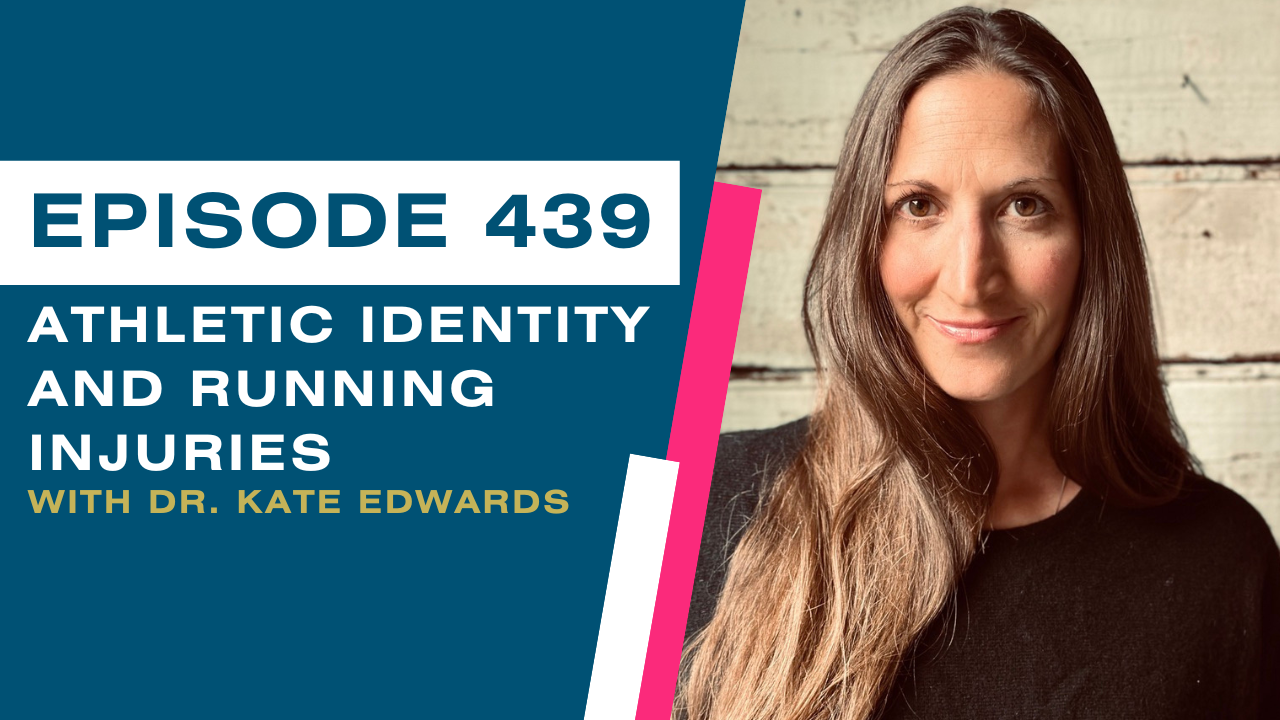
439: How Your Athletic Identity Influences Performance and Running Injuries with Dr. Kate Mihevc Edwards
Dec 11, 2025Athletic Identity, Injury, and Why “Doing More” Isn’t the Answer for Runners
What really makes someone a runner?
Is it your pace, mileage, race history—or the way running shapes your identity and your life?
In a recent conversation with Dr. Kate Mihevc Edwards, a physical therapist and running medicine specialist who works with the Atlanta Track Club elites, we explored athletic identity, injury risk, stress, and the unique challenges women, especially over 40, face in running.
If you’ve ever struggled to call yourself a runner, felt lost during injury, or used running as your main coping strategy, this is for you.
What Is Athletic Identity?
Athletic identity is how you see yourself in the world as an athlete. It’s:
-
How you describe yourself (“I’m a runner.”)
-
What you value and prioritize
-
How you structure your time, habits, and community
For many runners, it looks like:
-
Planning weekends around long runs
-
Eating to support training
-
Wearing race shirts and running shoes all the time
-
Socializing with running friends
A strong athletic identity can be powerful. Research shows athletes with strong identities are often more driven, more consistent, and more willing to push for big goals.
But it can also be risky when running becomes your whole identity.
When your self-worth, stress relief, community, and sense of purpose all hinge on running… an injury or health issue doesn’t just sideline your training—it can shake your entire sense of self.
When Running Is Everything—and Then It’s Taken Away
Kate shared a pivotal story from her own life: one year after having her son, she went into ventricular tachycardia during a training run and almost died.
It took 9–10 months to get a diagnosis: a rare genetic heart condition. In that time, she slowly lost what felt like pieces of herself:
-
She couldn’t run the way she used to
-
Her stress outlet disappeared
-
Her competitive goals vanished
-
Her identity as “a serious runner” crumbled
She experienced anxiety, depression, and a deep sense of loss.
What helped her rebuild?
-
Working with a sports psychologist
-
Learning to meditate, even when she hated it at first
-
Exploring other outlets: yoga, strength training, walking
-
Reframing what it means to be “a runner”
-
Shifting from “I’m only a runner if I’m fast and racing a lot” to “I’m a runner when I put on shoes and move my body”
-
Channeling her passion into running medicine, research, and helping other runners
Her story is a powerful reminder: Running can be central to your life—but it cannot be the only thing holding you together.
On the Other Side: “I Run, But I’m Not a Real Runner”
On the flip side, there are countless people who:
-
Run multiple times per week
-
Sign up for races
-
Wear the gear, follow training plans, buy the shoes…
…and still say, “I’m not really a runner.”
Usually, that comes from comparing themselves to “faster” or “more serious” runners, believing runners look or perform a certain way, or feeling like they haven’t “earned” the identity.
Here’s the belief both Kate and I share:
If you run, you are a runner.
You don’t need a certain pace, a certain distance, a marathon medal, or a specific body type. You can just decide to call yourself a runner.
Claiming that identity often helps people take their training and self-care more seriously, and opens the door to healthier choices around strength, nutrition, rest, and recovery.
Why So Many Runners Get Injured
Running injuries are common—over 80% of runners will get injured at some point.
Most people want a single cause, like shoes, mileage, or running form.
But running injuries are multifactorial. They’re influenced by:
-
Training load (how much, how fast, how often, and how quickly it changes)
-
Previous injuries
-
Strength and mobility
-
Biomechanics
-
Sleep
-
Nutrition & fuel timing
-
Hormones
-
Overall life stress
-
Nervous system regulation
You have ONE stress bucket and all of these things pour into it:
-
Physical stress (training, strength work, life demands on the body)
-
Mental stress (work, relationships, money, life pressures)
-
Emotional stress (anxiety, grief, big transitions, identity struggles)
Your body doesn’t separate them. It just knows how full the bucket is.
When the bucket overflows, it often shows up as:
-
Pain
-
Injury
-
Burnout
-
Exhaustion
This is why two runners can follow the same plan with wildly different outcomes. Their stress buckets—and recovery capacities—aren’t the same.
That’s why we also have to be careful when running for stress relief. Sure, running can:
-
Clear your mind
-
Release feel-good chemicals
-
Help you process emotions
-
Give you space from daily demands
But…
If every run is at a moderate or hard effort…
If you’re pushing through fatigue day after day…
If running is your only way of coping…
You’re likely adding physiological stress to a system that’s already overwhelmed, even if it feels mentally better in the moment.
Over time, this can push you closer to injury, illness, or total burnout.
Women Over 40: The Fueling, Hormones, and RED-S Connection
For women in perimenopause and post-menopause, there’s another layer of complexity.
Hormonal shifts affect:
-
Recovery
-
Muscle mass and strength
-
Bone density
-
Sleep quality
-
Mood
-
Body composition
Many women notice weight gain—especially around the midsection—and respond by:
-
Eating less
-
Training more
-
Cutting carbs
-
Skipping pre- and post-run fuel
This is a perfect recipe for relative energy deficiency in sport (RED-S): not eating enough to support the demands of your body and training.
RED-S can show up as:
-
Fatigue
-
Poor recovery
-
Frequent or recurrent injuries, especially bone stress injuries
-
Brain fog
-
Mood changes
-
Sleep issues
-
Hormonal disruption
And here’s the kicker:
Many symptoms of RED-S overlap with perimenopause.
So women often assume, “It’s just hormones,” when under-fueling is also playing a major role.
Key points we discussed:
-
Losing your period is a late sign of energy deficiency and doesn’t apply the same way once you’re in the menopause transition.
-
Carbs are critical for bone health, performance, and recovery.
-
Protein needs increase after 40—both total and per-meal.
-
Fuel timing matters, especially around workouts—before and after.
This is why I often tell my runners over 40:
“You probably need to eat more, run slower, and rest more.”
It sounds backwards.
But it’s often exactly what their body—and nervous system—needs.
We are absolutely in favor of pushing hard and going after big goals.
We just want those efforts to be strategic, supported, and sustainable.
At the end of the day, this conversation comes back to identity.
The healthiest version of athletic identity looks like:
-
“I’m a runner” and I’m also a parent, partner, friend, professional, whole human.
-
Running supports my life; it doesn’t replace it.
-
I use running as one of many tools for mental and physical health—not the only one.
-
I care about performance and I care about longevity, health, and joy.
And isn’t that what it’s all about?
Connect With Dr. Kate Edwards
You can learn more from Kate here:
-
Instagram: @katemihevedwards
She’s a fantastic resource on running medicine, RED-S, elite care models, and the whole-person approach to runners.
Enter your email address to get weekly episodes delivered to your inbox plus tips on how to become a physically and mentally stronger runner!
Don't worry, we won't blow up your inbox. We just want to send you some great info to help you in your running journey. We hate SPAM, and we will never sell your information, for any reason.
