
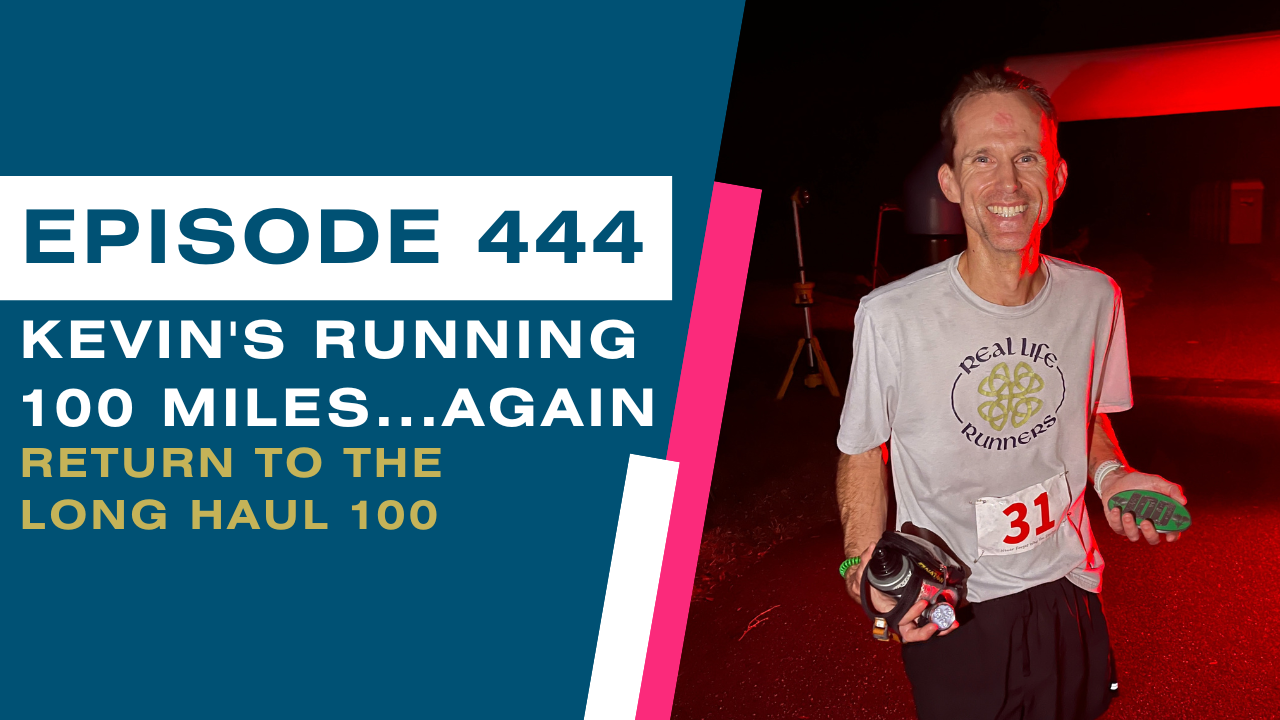
444: Kevin's Running 100 Miles...Again - Return to the Long Haul 100
Jan 15, 2026The Long Haul, A Few Days Out
What training for 100 miles teaches you about trust, fuel, and the kind of athlete you’re becoming.
There’s a particular energy that shows up in the final days before a big race—the kind where the work is done, the bags are half-packed, and your brain starts asking questions it didn’t care about three weeks ago.
Did I do enough?
Did I miss something?
What if this goes sideways?
And when the race is 100 miles long, those questions don’t whisper. They show up with a megaphone.
A few days before Kevin lines up for the Long Haul 100—his fourth 100-mile starting line—we sat down to talk it through. Not in a “let’s recite the training plan” kind of way. More like: what has this year actually required of you? What’s different than last year? What are you carrying into this race—physically, mentally, emotionally?
Because training for an ultra isn’t just building endurance. It’s building a relationship—with your body, with uncertainty, with effort, with the long middle miles where you don’t get applause, you just keep going.
And for Kevin this year, that relationship has evolved.
So why are you doing this race…again?
The Long Haul 100 isn’t just a race Kevin likes. It’s also practical. It’s the only Florida race that offers a qualifier for the Western States 100 lottery—ultrarunning’s Super Bowl, held each June in California. If you want a shot at that start line, you need lottery tickets. And in our case, Long Haul is the closest ticket you can earn without flights, complicated travel, or a huge logistics overhaul.
It’s classic Kevin: big goals, simple plan, maximum thrift.
But under that practicality is something deeper—something that started long before ultras became “his thing.”
Kevin had three seizures in 2017 with no clear cause. After a lot of tests and a lot of uncertainty, he asked a question that carried more weight than it should have had to: Can I keep running?
The answer wasn’t a confident yes. It was more like, “Sure… you can jog.”
Which is not how Kevin runs.
Sure, Kevin loves running, but he really loves seeing what’s possible for him.
He didn’t just want to return to running a few miles everyday—he wanted to return to the challenge of what was possible for him. And like a lot of people, COVID shifted the timeline from “someday” to “why not now?” The distances stretched. The curiosity grew. And the ultra world became a place where Kevin could test the edges of what he thought he could do.
That’s the thread that connects all of this: ultras aren’t just physical feats. They’re living proof that your future is not decided by your past.
The biggest difference between last year and this year: a healthy foundation
Last year’s build toward Long Haul was coming off a very real physical setback. Kevin ran the Daytona 100 in December 2023 with a hernia (0/10 recommend), then had surgery in March 2024 and had to rebuild slowly. That meant last year’s training was more compressed—less runway, fewer months of uninterrupted consistency.
This year, the foundation is simply stronger.
Not because the plan is drastically different, but because the body underneath the plan is different. The summer was better. The fall was steadier. The weekly volume has been slightly higher. Nothing dramatic—just the kind of consistency that adds up quietly until one day you look back and realize you’ve crossed 2,000 miles in a year.
Ultra training doesn’t reward perfection. It rewards accumulation.
What a “typical week” looks like for a 100-mile runner
A lot of people assume ultra training is just endless slow miles. But Kevin’s weeks include more variety than most runners expect.
Most weekday runs hover around eight miles, with a rhythm that balances endurance and speed:
-
Easy mileage to build durability
-
A tempo-style interval session (think moderate-hard effort that builds efficiency)
-
A faster session closer to 5K effort to keep the engine sharp
-
Strides—often harder than “traditional” strides—because ultra pacing still benefits from high-end speed and economy
And then the weekend becomes the real playground: long runs, sometimes back-to-back long efforts, not to “simulate 100 miles,” but to practice the things that matter most when the race gets long:
-
fueling
-
mental stamina
-
staying calm when your body starts negotiating
-
running on tired legs
His longest run in this build was 40 miles. Which leads to the question everyone asks…
“How can you run 100 miles if your longest run is 40?”
Because ultra math is different.
Marathon plans don’t include 26.2 in training either—and that gap is only six extra miles. With a 100-miler, the gap is huge, so it feels absurd.
But the point of long-run training isn’t to prove you can already do the whole thing. It’s to build the aerobic base, resilience, and systems support that make the full distance possible on race day.
And in ultras, the strategy changes the demand.
Kevin put it perfectly: if a marathon runner showed up to a marathon start line and someone told them, “Surprise, it’s a 100K,” many could still finish—if they adjusted their intensity enough. Not because it would be comfortable, but because the human body is wildly capable when you stop trying to force marathon effort into ultra distance.
The limiter is rarely “can your legs move.”
It’s: can your mind stay with you long enough to keep going?
And: can your gut keep up with what your body requires?
The sneaky problem that showed up this cycle: Monday headaches
One of the most interesting patterns we noticed this training block wasn’t in the workouts—it was in the recovery.
Kevin has had more headaches on Mondays, the day after long runs. And when we actually looked at the pattern, the likely culprit wasn’t dehydration. It was under-fueling after the run.
Here’s the trap: when you fuel well during the long run, you often feel better afterward—so you do more, move more, stay busy… and forget that recovery still demands calories. A long run doesn’t end when you hit stop on your watch. Your body keeps working for hours—and even 1-2 days—refilling glycogen, repairing tissue, restoring balance.
Ultra training is not just about what you can endure. It’s about what you can replace.
And the day after a long run?
That’s not a “eat less because you’re resting” day.
That’s a rebuild day.
Fueling for ultras: it’s not “healthy,” it’s effective
If you’re expecting an ultra runner’s nutrition strategy to sound like “whole foods and clean eating,” this might surprise you.
Ultra fueling has shifted hard toward high-carb intake. The athletes winning races are taking in numbers that sound ridiculous until you remember what they’re doing: running for 12–20+ hours.
Kevin’s approach this year is more refined:
-
more liquid calories
-
less thick gels
-
more carbs per packet
-
less GI distress risk
He found a gel that’s basically liquid sugar without added flavoring—just sweet, easy to swallow, and easier to tolerate hour after hour (it’s called Carbs Fuel, if you’re wondering).
Remember: Race nutrition is not the same as daily nutrition.
You can eat mostly whole foods 99% of the time and still choose processed fuel during long races because your body needs something fast, absorbable, and low-fiber. Real food can absolutely have a place—especially if you’re doing more walking—but “what’s healthiest” in everyday life isn’t always “what works” at hour eight.
The goal isn’t to win a clean-eating contest.
It’s to keep your body moving forward.
Gut training is training
One of the moments you might not have expected in this conversation was Kevin casually mentioning he practiced fueling by intentionally making his stomach feel full… and then going for a run.
That’s not insanity. That’s strategy.
Your gut is trainable—sometimes even more quickly than your muscles. But it’s also more quickly de-trainable. Which means you can’t fuel successfully once and assume you’re “good.” You have to keep practicing, keep exposing your system to what you plan to use on race day, and keep building tolerance.
This is a huge lesson for marathoners too: don’t wait for race day to test your fueling. Your stomach is part of your performance.
The mindset shift that makes ultra training possible: treating it like an experiment
This is the part I want every runner to hear.
Kevin has been racing for 30 years. He’s run enough races to know pressure can either sharpen you or break you. And what’s changed most over the years is this:
He doesn’t define success by placement.
He defines success by execution and learning.
Ultras are still a leap into the unknown. That uncertainty could feel terrifying—but Kevin uses it to soften pressure.
“I’m going to go out and put forth the best performance I can. I could finish 20th. I have no idea. That’s not the point.”
That mindset is gold for every distance runner. Because it protects you from the trap of believing that anything short of a perfect outcome means failure.
A slower race isn’t a moral statement.
A rough day isn’t proof you’re not an athlete.
Sometimes it’s just data.
A goals, B goals… and holding them loosely
Kevin’s A goal for Long Haul this year is bold: sub-16 hours. That’s under a 10-minute mile average, across 100 miles, with aid station stops, fatigue, and inevitable discomfort.
But the magic isn’t the number.
The magic is how loosely he holds it.
“If two miles in it’s not there, I’ll adjust. I know I can do 18. I’ve done 18.”
That’s what experienced runners do well: they plan, and they adapt. They don’t cling to a goal so tightly that it ruins the entire day.
The most “Kevin” race strategy: walk to eat
One practical example of adaptation is his simple run-walk strategy.
Not a rigid “run 10, walk 3” plan. More like a rule that supports digestion and consistency:
Every time he eats, he walks.
It makes fueling easier, reduces choking/sloshing, improves digestion, and creates built-in breaks that don’t feel like giving up.
It also reinforces something we talk about all the time: in long races, you don’t win by being tough for 100 miles. You win by being smart for 100 miles.
Two days out: done training, still negotiating
The funniest thing about taper week is that your body can feel ready… while your brain runs a full-time negotiation.
Kevin described it perfectly: freedom and nerves, on repeat.
The training is done. You can’t build more fitness now. All you can do is recover, fuel, sleep, and avoid doing something dumb.
And still, the question comes back: Is it enough?
If you’ve ever felt that before a marathon, a big goal race, or even a personal milestone—welcome to being human. The goal isn’t to eliminate the question.
The goal is to keep moving forward even when it shows up.
Follow along
If you want to follow the race in real time, we’ll be sharing updates on Instagram (service can be spotty in the state park, but we do our best), plus there’s live tracking through timing mats. It’s me and our two daughters crewing Kevin again—one of my favorite traditions, and honestly, some of our most watched stories all year.
Because whether the day goes smoothly or sideways… It's always a story.
And that’s the truth about ultras, and maybe about running in general:
You don’t do it because you can guarantee the ending.
You do it because you’re willing to show up for the next chapter.
If you’re reading this and you’re carrying your own “big thing” into this year—your own goal, your own starting line—let this be your reminder:
You don’t need certainty.
You need curiosity.
You need fuel.
You need trust in the work you’ve done.
And then you take the next step.
Now get out there and run your life.
Enter your email address to get weekly episodes delivered to your inbox plus tips on how to become a physically and mentally stronger runner!
Don't worry, we won't blow up your inbox. We just want to send you some great info to help you in your running journey. We hate SPAM, and we will never sell your information, for any reason.
