
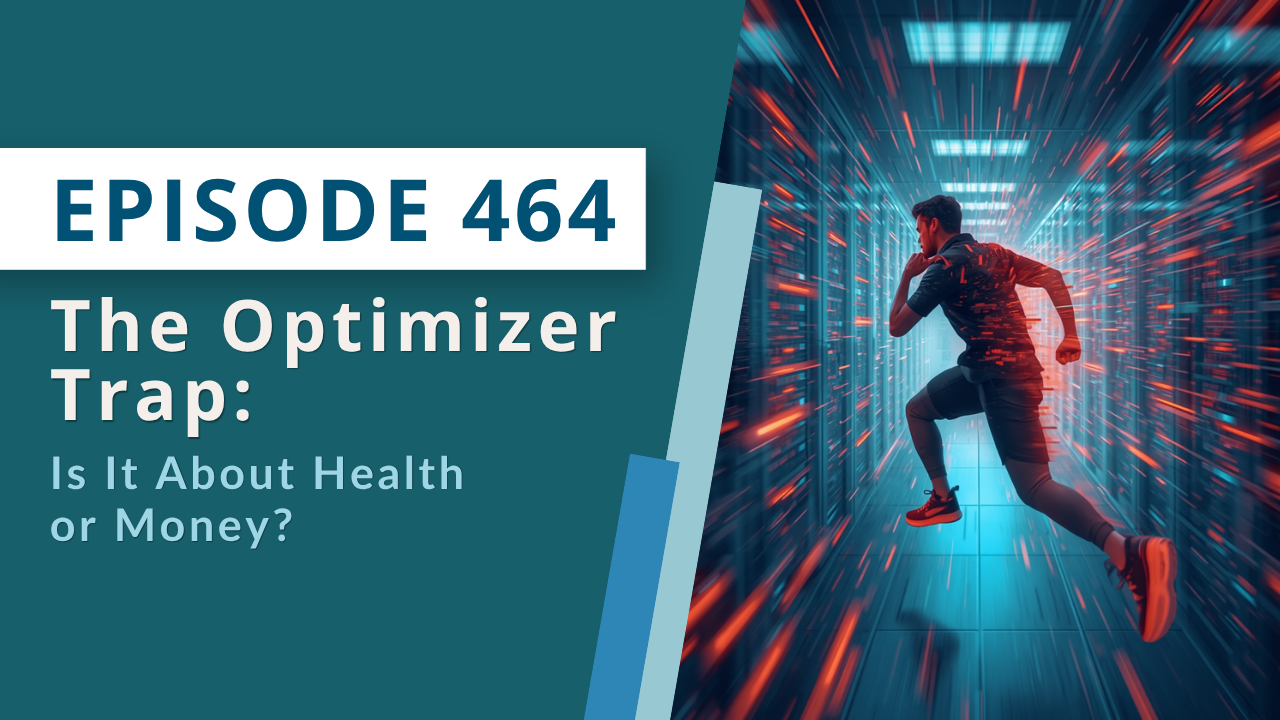
464: The Optimizer Trap: Is It About Health or Money?
Jun 04, 2026
We live in a time when it has never been easier to collect data about ourselves. We can track our sleep, recovery, stress levels, heart rate variability, glucose responses, daily movement, calorie intake, and just about every other aspect of our health. With a few taps on our phones, we can access more information about our bodies than most people had available just a decade ago.
On the surface, this seems like a good thing. More information should help us make better decisions, right?
Maybe. But only if we use that information correctly.
In this week's podcast, Kevin and I explored what we call the optimizer trap. It is the tendency to believe that if we can just gather enough data, track enough variables, and find enough marginal gains, we can finally unlock the perfect version of ourselves. The problem is that many people end up spending so much time trying to optimize their health that they lose sight of what health is actually supposed to do. Instead of helping us live our lives more fully, health becomes another project to manage, another source of pressure, and another thing to get right.
This shift has given rise to a new identity in the health and fitness world: the optimizer. The optimizer is always searching for the next edge. They want the best recovery protocol, the best supplement stack, the best sleep score, the best glucose response, and the best training metrics. Improvement becomes the goal, regardless of whether that improvement actually translates into a better quality of life.
The challenge is that many of the metrics we rely on are not nearly as objective as we think they are. Sleep scores, readiness scores, recovery metrics, and other health data points are often based on proprietary formulas that we do not fully understand. Yet many people allow those numbers to determine how they feel about themselves before the day has even begun.
I have seen runners wake up feeling rested and energized, only to question themselves because their watch told them their recovery score was low. I have seen athletes become anxious about a night of imperfect sleep because an app suggested they were not fully recovered. In these situations, the data is no longer providing insight. It is creating doubt.
We need to remember that data is a tool, not a dictator. It should help us better understand our bodies, not disconnect us from them. If a metric causes more anxiety than awareness, it may be worth questioning whether that metric is actually serving you.
This conversation becomes even more important when we look at conditions like orthorexia and orthosomnia. Orthorexia is an unhealthy obsession with eating perfectly. Orthosomnia is an unhealthy obsession with achieving perfect sleep. Both are becoming more common as people pursue health with increasingly rigid rules and expectations.
What begins as a desire to improve can slowly evolve into something much different. Food becomes stressful. Sleep becomes stressful. Social situations become stressful. Instead of feeling healthier, people often feel more restricted and more anxious. Ironically, the pursuit of wellness can end up undermining the very well-being it was supposed to create.
One of the most important concepts we discussed in this episode is the difference between fragility and resilience. Much of the optimization industry profits from the idea that our bodies are fragile. We are told that one poor night of sleep, one missed workout, one meal out with friends, or one glass of wine will significantly impact our health and performance. The underlying message is that we need constant monitoring and intervention to stay healthy.
But that is not how resilient systems work.
The human body is remarkably adaptable. It is designed to handle fluctuations, recover from challenges, and respond to stress. True health is not about eliminating every possible stressor. It is about building the capacity to handle those stressors and continue moving forward. Resilience is not created by avoiding life's challenges. It is developed through experiencing them, recovering from them, and learning that you can handle more than you think.
This idea became especially relevant as we discussed the Enhanced Games in Las Vegas. The event generated significant attention because athletes were allowed to openly use performance-enhancing drugs in pursuit of extraordinary performances. The organizers promoted the event as a new era in human performance and promised results that would redefine athletic achievement.
What actually happened was far less impressive.
Many of the record-breaking performances that were anticipated never materialized. In fact, the athletes competing WITHOUT enhancement protocols won three event. The event ultimately highlighted something that experienced athletes have known for a long time: there are no shortcuts that can replace years of consistent training, disciplined preparation, and mental toughness.
The Enhanced Games also exposed something larger about the wellness and performance industry. At its core, much of the optimization space is built around selling solutions. Often, those solutions are presented as the missing piece standing between you and your goals. The problem is that many people are searching for advanced solutions before they have mastered the fundamentals.
Before worrying about recovery gadgets, are you consistently getting enough sleep? Before investing in another supplement, are you eating enough quality food? Before searching for another training hack, are you following a well-designed plan? Before buying the latest recovery tool, are you managing your overall stress load?
These questions are not exciting, but they matter far more than most of the products being marketed to us.
The runners who experience the greatest long-term success are rarely the ones chasing every new trend. They are the ones who consistently focus on the basics. They prioritize sleep. They fuel their bodies appropriately. They build strength. They recover intentionally. They train progressively and remain patient with the process. They are socially connected.
That is not because the basics are flashy. It is because the basics work.
As you reflect on this episode, consider how your relationship with data and optimization is affecting your life. Are your metrics creating insight or anxiety? Are your devices helping you make decisions or making decisions for you? Are you focusing on the foundations that truly matter, or are you looking for solutions to problems that do not actually exist?
The goal is not to reject technology or ignore data altogether. The goal is to keep those tools in their proper place. Use them when they provide useful information. Set them aside when they begin to create unnecessary stress.
At the end of the day, your body is not a machine that needs constant tweaking and optimization.
It is an adaptive, resilient system that hrives when given the right inputs consistently over time.
Sleep, nutrition, movement, strength training, recovery, and stress management will always provide a greater return on investment than the latest biohack.
Trust the process. Trust your body. Focus on the fundamentals.
They have always been enough.
Enter your email address to get weekly episodes delivered to your inbox plus tips on how to become a physically and mentally stronger runner!
Don't worry, we won't blow up your inbox. We just want to send you some great info to help you in your running journey. We hate SPAM, and we will never sell your information, for any reason.
