
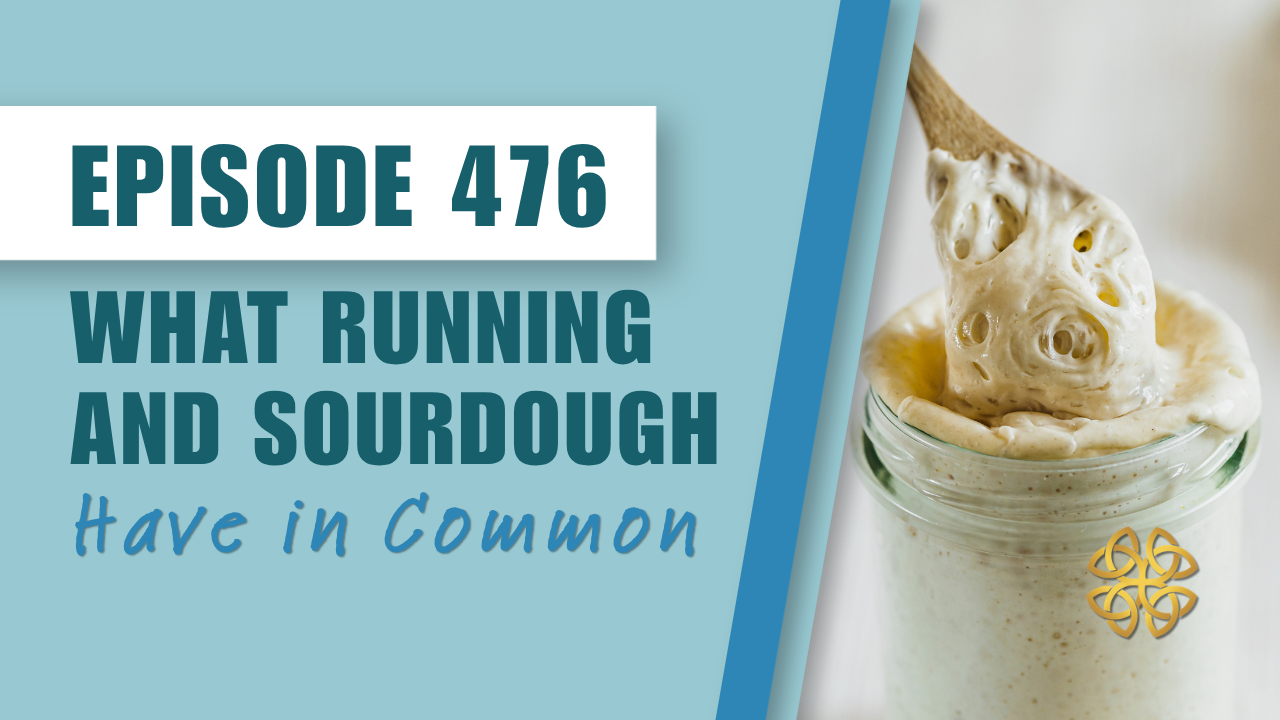
476: What Running and Sourdough Have in Common
Aug 27, 2026This summer, my daughter wanted to learn how to make sourdough, so I thought, “Sure, why not? Seems like a good summer project.”
Though I’m not a natural baker, I’ve become pretty good in the kitchen. I can follow a recipe. I can make things that taste good. I looked at the recipes, and they were simple. A few ingredients. Time and patience. So I thought, “No problem. This will be easy.”
But like most things, simple doesn’t always mean easy.
And so it began.
The Starter
I decided to make a starter from scratch. To do this, I combined equal parts flour and water then let it sit overnight. The next day, the recipe told me to discard most of it, and add more flour and water. Let it sit again. I had to repeat this every single day — and for the first several days, nothing visible happens.
Then something starts to bubble. Then it rises a little. Then — in my case, around day eight or nine — it seemed to just stop. No bubbles. No rise. It looked like something had died in the jar.
I genuinely thought I had killed it. People always talk about how hard and finicky sourdough is. But I followed the steps, what could have gone wrong?
I googled and read blogs to figure out what happened.
Please don’t tell me all of this has been for nothing.
Thank goodness, it wasn’t. Turns out, it’s normal for the starter to go through a dormant period where it stops rising for a few days.
The wild yeast was still there, still working, still establishing itself beneath the surface in ways I couldn't measure or observe. The plateau wasn't a failure. It was the foundation.
It took me two full weeks before my starter was consistently active and ready to bake with.
Two weeks of doing the same simple thing every single day with no visible proof it was working.
If that doesn't sound like the early weeks of a training plan, I don't know what does.
Base building looks exactly like a sourdough starter. You run the easy miles. You do the strength work. Your pace doesn't visibly improve. Your fitness doesn't feel different. You start wondering if the process is working — if maybe you're one of the people for whom it just doesn't work.
It's working. The aerobic system is building beneath the surface — mitochondrial density, capillary development, connective tissue adaptation — none of it is visible in your daily run, but all of it is happening. The culture is establishing itself.
Keep feeding the starter. Keep doing the thing. Especially when it looks like nothing is happening.
Now my starter is established, so I never have to do this again. I can use this starter for years to make delicious sourdough recipes, all because I took the time to do it right the first time and not rush the process.
Four Ingredients
Now that I have an active starter, I can make bread whenever I want. Making sourdough bread requires exactly four ingredients.
Starter (Natural Yeast). Water. Flour. Salt.
That's it. No additives. No special equipment. No shortcuts. The magic is entirely in the process, and the simplicity of the ingredients.
The fundamentals of running are just as simple: progressive training load, strength work, sleep, and fueling. Four ingredients. That's the whole recipe.
We keep looking for the fifth ingredient — the supplement, the device, the special protocol — when the magic was always in the four things we already had. The simplicity is not a limitation. The simplicity is the point.
The simplicity leads to results. Not the fancy equipment or the crazy, complicated speed workout. Four ingredients. Mastered over time.
Stretch and Fold
After mixing the 4 ingredients to make the dough, I let it rest. Then every 30 minutes for 2 hours I do a stretch and fold.
Online sourdough tutorials told me to grab one side of the dough, stretch it up as far as it will go without tearing, and fold it back over itself. Turn the bowl. Repeat on all four sides. Let it rest for 30 minutes, then come back and do it again.
This process develops the gluten network that gives the bread its structure and strength. The coolest part is that I can feel the dough changing under my hands with each fold — getting more elastic, more resilient, more capable of holding its shape under pressure.
You cannot do all the folds at once. I tried to think about this — what if I just folded it fifty times right now and skipped the waiting? It doesn't work that way. The rest between folds is not filler. The dough is reorganizing during the rest. The gluten network is consolidating. The rest is part of the process.
Every training session is a stretch and fold. Every strength session. Every easy run. You are developing the network — muscular, neurological, connective tissue — that gives your running its structure and resilience. And the rest days, the easy days, the recovery weeks — those are not empty space between the work. They are where the work becomes something.
You cannot compress a 16-week training cycle into 4 weeks. You cannot do all the folds at once. The dough will tear. The body will break down.
Do the fold. Rest. Come back. Do it again.
The Bulk Rise
After the stretch and fold phase the dough sits on the counter for about 8 hours where it does its main rise, then I shape it into a cute little ball, and put it into the refrigerator overnight — sometimes 8 hours, sometimes 12, sometimes longer. I do nothing. I go to sleep. The dough does all the work.
What's happening inside: fermentation. Wild yeast consuming the sugars in the flour, producing carbon dioxide that creates the air pockets — the open crumb structure that makes sourdough what it is. The flavors developing. The complexity building.
If you rush the bulk rise — pull it out too early, bake it before it's ready — you get a dense, flat loaf. The flavor isn't there. The structure isn't there. The time was the ingredient you skipped.
Sleep is the bulk rise.
This is when adaptation actually happens — muscle protein synthesis, hormonal restoration, glycogen replenishment, nervous system recovery. The training session is the stretch and fold. Sleep is where the training becomes fitness. The athlete who trains hard and sleeps poorly is like the baker who does perfect stretch and folds and then pulls the dough after two hours. The work was done. The transformation wasn't allowed to complete.
Recovery weeks work the same way. The fitness you built in the hard weeks consolidates during the down week. Skipping recovery doesn't make you fitter. It makes you a dense, flat loaf.
Let the dough rise. Let yourself rest. The rise is where it gets built.
The Scoring
The next morning, it’s time to bake. Before baking sourdough the tutorials told me to score the top of the loaf, making deliberate cuts with a sharp blade in a specific pattern. This looks like decoration but it is entirely functional: it creates a controlled place for the loaf to expand in the oven.
Without scoring, the bread still expands. But it bursts at its weakest, most unpredictable point — wherever the structure is least able to hold. The scoring doesn't limit the rise. It directs it.
A training plan is the scoring. It creates intentional places for growth to happen — hard weeks, easy weeks, race-specific work, built-in recovery. Without structure, growth still happens. But it tends to happen at the weakest point — overuse injury, burnout, plateau — because there was nothing directing the expansion.
The plan doesn't limit your potential. It directs it toward the right places at the right times.
The Oven
On day 3, it was time to bake, so I preheated the oven to 500 degrees. Hotter than almost anything else I bake. You bake the loaf covered for the first 20 minutes to trap steam, then uncover it for the final 20–25 minutes to develop the crust.
The heat that sounds extreme is exactly what's needed. It's what creates the crust, the color, the texture, the flavor. Without that heat the bread is pale and soft and hasn't become what it's capable of.
The dough goes in looking like dough. It comes out as something completely different. The transformation required the heat.
Your hard efforts are the oven. Tempo runs, intervals, races, the training blocks that push you past comfortable — these are the heat that transforms. Easy running builds the base. The heat of hard effort converts that base into real performance capacity. Both are necessary. A loaf that never goes in the oven never becomes bread. A runner who only does easy miles never fully develops what the base can become.
And the hard seasons — the injuries, the setbacks, the training blocks that humbled you — they are the oven too. They are not happening to you. They are happening for you. What comes out on the other side is something the raw dough could never have been.
Every Loaf Is Different
Even with the same recipe, the same starter, the same process — humidity, temperature, flour batch, timing all affect the outcome. Some loaves are better than others. Some have beautiful open crumb structure. Some are denser than I wanted. I learn from every single one.
The baker doesn't quit after a dense loaf. She asks what was different this time — was the bulk rise too short? Was the kitchen too cold? Was the starter not quite at peak? She adjusts and tries again.
Some training cycles are better than others. Some races go exactly as planned. Some don't. The question is never should I stop. It is always, “What does this loaf teach me?”
And just like your starter is unique to your environment — your training is unique to your body, your life load, your season, your history. Stop comparing your loaf to someone else's. Your kitchen might be warmer or colder. You might need to slightly adjust how much water, salt, flour, or starter to add. The 4 ingredients are the same. The recipe can adjust.
The Rise Is Coming
Sourdough is not convenient. It is not fast. It cannot be hacked or optimized or rushed into something it isn't ready to be.
It requires you to show up every day and do the simple thing. To trust the process when nothing visible is happening. To rest when the process calls for rest. To apply heat when transformation is needed. To let the rise happen on its own timeline.
Running is exactly the same.
The starter that looks dead on day ten becomes the culture that makes the bread. The training block that feels like it's going nowhere becomes the fitness that carries you across the finish line.
Keep feeding the starter. Keep showing up. The rise is coming.
Enjoyed this post? Listen to the full episode on the Real Life Runners Podcast. And if you're ready to build a training practice with the patience, consistency, and trust that sourdough has taught us both — learn more about the Running Reconnected Team at realliferunners.com/team.
Enter your email address to get weekly episodes delivered to your inbox plus tips on how to become a physically and mentally stronger runner!
Don't worry, we won't blow up your inbox. We just want to send you some great info to help you in your running journey. We hate SPAM, and we will never sell your information, for any reason.
