
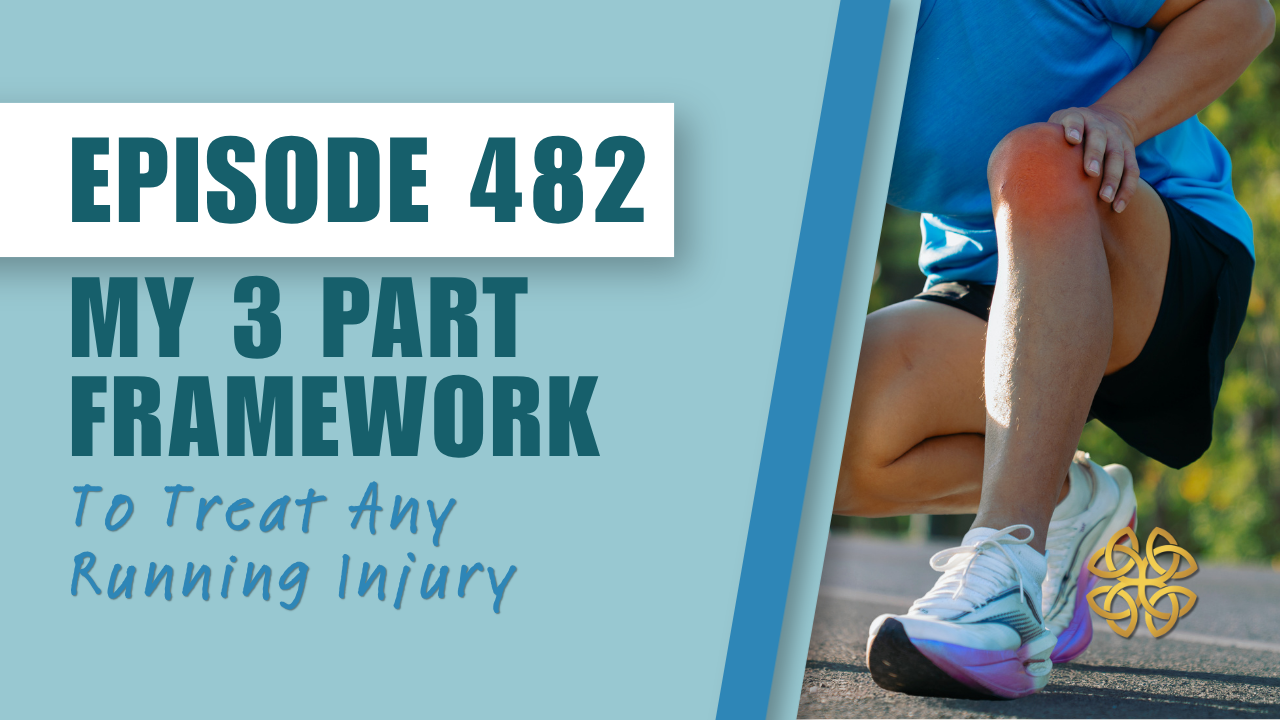
482: My 3 Part Framework To Treat Any Running Injury
Oct 08, 2026My PT Framework to Evaluate and Treat Any Running Injury
Over the past 2 months, I’ve experienced more pain than I have in the past 10 years.
As a PT, that’s an interesting place to be. Part of me is confused — where did this come from? I know how to train, I follow my own training advice, so this shouldn’t be happening.
Part of me feels a little shame — how could I have let this happen? If I can’t prevent pain in myself, how am I supposed to help everyone else?
Neither is helpful. Both are human.
The truth is, being an active woman who runs and strength trains comes with an inherent risk of injury. Running is a repetitive activity and places a high load and demand on the body. When I strength train, I am literally doing things that break the body down so that I can get stronger.
Plus, as a 45 year-old woman in perimenopause, my body is changing.
So instead of feeling confused and shamed, I decided to treat myself like I would treat any client and figure this thing out.
There is a specific process that I use anytime I work with someone in pain to not only address the symptoms, but also to get to the root cause and treat it at the source.
Today, I want to pull back the curtain and show you my PT framework that I use to evaluate and treat any running pain or injury, with myself or my clients.
I call it my EAT framework: Evaluate, Assess, and Treat. This is the process I use to understand pain, figure out what matters most, and help runners return to movement without simply guessing.
Evaluate (the Whole Story)
When a runner comes to me with knee pain, I do not immediately start with knee exercises. First, I want to understand the pain story. Where is it? When did it start? What makes it better or worse? Is it sharp, dull, aching, or burning? Is it improving, staying the same, or getting worse?
Then I look at the load story, because running injuries often do not happen in one obvious moment. What has changed in your training?
Maybe you added mileage, started speed work, changed shoes, added hills, began a new strength program, or started running more days per week. There are any number of things that might seem like “no big deal” but change how our bodies are loaded.
Sometimes the change seems small. I experienced this myself when I started running more with my dog. The runs were short and easy, but they were still more load than walking, and every time he pulled sideways, my body had to stabilize against that extra force. Eventually, my knee started bothering me.
This is why I often think about pain as a relationship between load and capacity. Running places stress on the body, and that is not a bad thing. We need stress in order to get stronger.
Problems start when the load we are asking our body to handle becomes greater than its current ability to handle it.
Training load is only one part of that picture. Sleep, stress, fueling, strength training, hormones, previous injuries, and recovery all matter. Two runners can follow the exact same training plan and have completely different responses if one is sleeping well and eating enough while the other is stressed, underfueled, and exhausted.
Know When Pain Needs More Attention
During my evaluation, I also screen for things that need more medical attention. Not every pain should be self-managed. Significant trauma, worsening numbness or weakness, unexplained weight loss, fever, loss of bowel or bladder control, or pain that remains constant at rest should be evaluated by a medical professional.
Runners also need to be careful with possible bone stress injuries. Pinpoint tenderness over a bone, pain that progresses from after running to during running to walking or resting, pain with hopping, or symptoms that continue to worsen even after reducing training are all reasons to get checked. This is especially important if there has been a rapid increase in training, a previous bone stress injury, low energy availability, recent weight loss, irregular periods, hormone changes (like in peri/post menopause), or lower bone density.
Getting evaluated does not mean you failed or that you will automatically be told to stop running. It simply gives you better information about what your body needs.
Assessment — Putting it Together
Once we gather the information, the next step is figuring out what actually needs to be addressed first. Most runners do not have just one thing going on. Maybe ankle mobility is limited, hip stability needs work, mileage increased, and sleep has been terrible. All of those things might matter, but we do not have to fix everything at once.
I also look at what kind of pain we are dealing with. Is it mechanical, nerve-related, or inflammatory in nature? That helps guide our treatment plan.
I also look at how irritable the tissue is. How easily does the pain flare up? How long does it take to settle down? If one simple movement causes a big increase in pain that lasts for hours, we need to move more slowly. If mild discomfort settles quickly and the body handles the activity well, we may be able to progress sooner.
That is why recovery should not be based only on a timeline. Instead of asking, “How many weeks until I can run normally again?” ask, “What can my body tolerate right now, and how can I gradually build from there?”
Treat — Without Automatically Stopping Everything
One of the biggest mistakes runners make is going to one extreme or the other. We either push through pain because we are afraid of losing fitness, or we avoid movement completely because we are afraid of making things worse.
Most tissues need some amount of movement and load to get stronger. The goal is finding the right amount. This is known as optimal loading.
One guideline I often use is keeping pain around a 4 out of 10 or lower during activity while also watching the trend. If you start at a 2 and the pain keeps climbing to a 5, 6, or 7, the load is too much. We pull back and modify.
If it starts at a 4 and stays the same or decreases, we are on the right track.
I also use the 24-hour rule. How do you feel during the workout, immediately afterward, and the next day? If symptoms are the same or better 24 hours later, that is generally a better sign that your body tolerated the load. If pain is clearly worse the next day, that is useful feedback. What you did was probably too much, so you adjust.
This does not mean you failed. Your body simply gave you information.
Rebuild Mobility, Stability, and Strength
When we start rebuilding, I usually think about three things: mobility, stability, and strength.
Mobility is your ability to move through the range of motion you need.
Stability is your ability to control your body through that movement without compensating.
Strength is your ability to handle more resistance and load once that movement is controlled.
This is also why I do not only look at the body part that hurts. Hip pain may be connected to what is happening at the ankle, knee, or spine. The body is incredibly good at finding ways around restrictions, but eventually those compensation patterns can create problems somewhere else.
For running, we also modify the load instead of automatically dropping it to zero. That might mean temporarily reducing mileage, cross-training, or using run-walk intervals. If you normally run 20 miles per week, cutting that substantially for a period of time may be enough to let the tissue calm down while still keeping you moving.
The goal is not always complete rest. The goal is finding the amount of load your body can handle without making things worse.
Fix What Caused the Problem
Getting out of pain is only part of the process. We also have to look at why the problem developed in the first place.
Common causes are ramping up mileage too quickly, not strength training, sleeping five hours per night, or dieting while increasing your running volume. If we return to the same habits without addressing those factors, the problem can easily return.
This becomes even more important as we get older. Running cannot exist in isolation. Strength matters. Mobility and stability matter. Sleep matters. Fueling matters. Stress matters.
None of these things are exciting hacks, but they help build a body that can tolerate more load and continue running for years.
Start With One Change
When pain shows up, it is easy to panic and feel like everything needs to change. Instead, get curious. What changed before the pain started? How has your training been? How is your recovery? Are you eating enough? Sleeping enough? Strength training consistently?
Then choose one thing to work on this week.
You do not need to fix everything at once. The goal is to keep listening, adjusting, and gradually building your body’s ability to handle the running you want to do.
Consistency will take you much farther than trying to get everything perfect.
If you’re looking for an expert with 20 years of experience that can guide you in this process, send me an email at [email protected] — tell me a little bit about what’s going on, what you want to achieve, and let’s chat to see if you want support to help you get there faster.
Enter your email address to get weekly episodes delivered to your inbox plus tips on how to become a physically and mentally stronger runner!
Don't worry, we won't blow up your inbox. We just want to send you some great info to help you in your running journey. We hate SPAM, and we will never sell your information, for any reason.
