
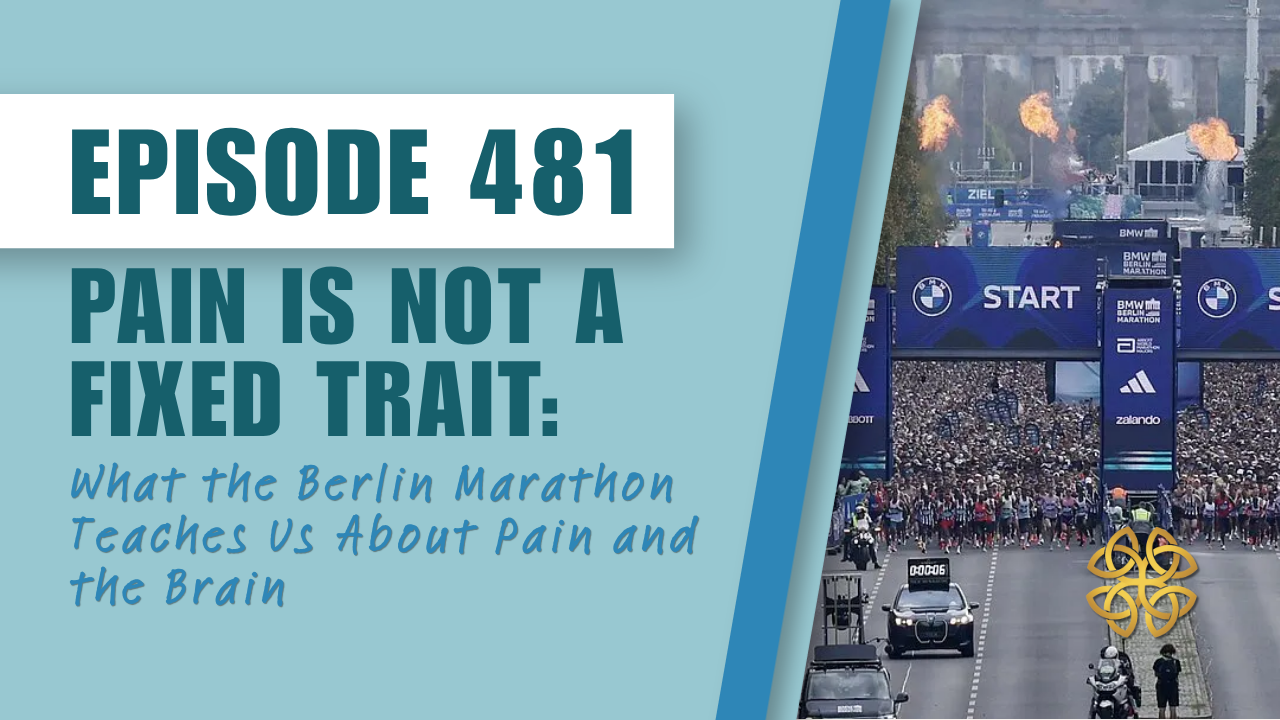
481: Pain Is Not a Fixed Trait: What the Berlin Marathon Teaches Us About Pain and the Brain
Oct 01, 2026What Tigst Assefa's Berlin Marathon Finish Teaches Us About Pain
On Sunday, Tigst Assefa won the Berlin Marathon in 2:11:04.
It was a course record and the third-fastest time a woman has ever run.
According to her manager, she also ran the final stretch (about 2k) on a completely ruptured Achilles tendon.
He says the pain started around 31K and intensified near 40k, which is when it likely ruptured. For the last 2km, she limped the entire way. She still finished and won.
She was rushed to the medical tent, evaluated, and had surgery the next day.
I haven't stopped thinking about it. Not because it's inspiring, exactly. Because it raises a question every runner has asked at some point:
How is that possible?
Pain Is an Output, Not a Measurement
The usual answer is "elite athletes have a superhuman pain tolerance."
The research says something more interesting.
Your tissues send danger signals to your brain. That's called nociception, and it is not pain.
Pain is what your brain produces after weighing that signal against everything else it knows: the context, the meaning, your expectations, your fear, your stress, your sleep, and what you're trying to accomplish.
That's why the same signal can hurt a lot on one day and barely register on another.
Pain exists to get you to change your behavior. It’s one way your body communicates with you.
When something else matters more, the brain can turn it down.
How the Brain Turns the Volume Down
Descending modulation. Your brain can dampen incoming signals at the spinal cord using its own opioid and cannabinoid systems. Much of that mechanism work comes from animal studies, but the human evidence is real.
Stress-induced analgesia. High arousal and high stakes can suppress pain. This varies from person to person and is shaped by age, sex, and prior experience (Butler & Finn, 2009).
Exercise-induced hypoalgesia. Exercise itself raises pain thresholds, with larger effects at higher intensities (Naugle et al., 2012, 2014). It's temporary and has been studied with lab-induced pain. Exercise has been shown to decrease chronic pain.
Goal and attention. A world record on the line pulls attention and resources toward the finish line. That's our interpretation, not something anyone measured in Tigst. But it fits what the science suggests.
Do Elite Athletes Just Feel Less?
Partly, and the details matter.
A meta-analysis of 15 studies found athletes have higher pain tolerance than active non-athletes (Tesarz et al., 2012). Triathletes in one study rated the same painful stimulus as less painful, not just more bearable. They also had lower fear of pain and more efficient pain inhibition (Geva & Defrin, 2013).
These studies compare athletes to non-athletes at one moment in time, so we can't say whether training builds this ability or people with strong pain modulation gravitate toward endurance sport.
But here’s something super interesting...
When researchers put those same triathletes under acute psychological stress, their advantage disappeared. Their pain modulation dropped to non-athlete levels (Geva et al., 2017).
So it isn't a fixed trait. It changes with context.
The Volume Knob Isn't Only for Elites
Clinicians and researchers have long observed that meaning and situation change pain. A serious wound can hurt less when it means you're alive and getting out. Labor can be intensely painful and still feel purposeful, especially with support and a sense of control. And stories of people finding strength to save someone else are a reminder that danger can suppress pain so action can continue. Those stories are anecdotal, but stress-induced analgesia is real.
What these share: a high-stakes goal, meaning, arousal, and often other people.
What Turns Pain Up
- Poor sleep. One night of total sleep deprivation increased pain sensitivity and impaired the brain's pain-inhibiting system in healthy adults (Staffe et al., 2019).
- Stress and anxiety
- Fear of pain and catastrophizing
- Reading the sensation as a threat
- Paying attention to the sensation
- Isolation and low mood
What Turns Pain Down
- Sleep
- A goal that matters, and a sense of control
- Attention directed outward
- Social support
- Movement itself
- Slow, steady breathing
- Familiarity from training
You Don't Have a "Low" or "High" Pain Tolerance
You have a nervous system that responds to context. What you tell yourself, how you slept, how much stress you're carrying, and what the moment means to you all shape it.
Some of that is yours to influence.
Pick one this week. Protect your sleep. Change one thing you say to yourself on a hard effort. Practice slow breathing when it gets uncomfortable.
That's the training.
Listen to the full conversation on the Running Reconnected Podcast, Episode 481
References
- Tesarz J, et al. Pain perception in athletes compared to normally active controls. Pain. 2012;153(6):1253-1262. doi:10.1016/j.pain.2012.03.005
- Geva N, Defrin R. Enhanced pain modulation among triathletes. Pain. 2013;154(11):2317-2323.
- Geva N, Pruessner J, Defrin R. Triathletes lose their advantageous pain modulation under acute psychosocial stress. Med Sci Sports Exerc. 2017;49(2):333-341. doi:10.1249/MSS.0000000000001110
- Butler RK, Finn DP. Stress-induced analgesia. Prog Neurobiol. 2009;88:184-202. doi:10.1016/j.pneurobio.2009.04.003
- Naugle KM, Fillingim RB, Riley JL. A meta-analytic review of the hypoalgesic effects of exercise. J Pain. 2012;13(12):1139-1150. doi:10.1016/j.jpain.2012.09.006
- Naugle KM, et al. Intensity thresholds for aerobic exercise-induced hypoalgesia. Med Sci Sports Exerc. 2014;46(4):817-825.
- Staffe AT, et al. Total sleep deprivation increases pain sensitivity, impairs conditioned pain modulation and facilitates temporal summation of pain in healthy participants. PLoS ONE. 2019;14(12):e0225849. doi:10.1371/journal.pone.0225849
- Tigst Assefa race details: AP (via Yahoo Sports, Sept. 29, 2026), CBC Sports, and Marathon Handbook
Enter your email address to get weekly episodes delivered to your inbox plus tips on how to become a physically and mentally stronger runner!
Don't worry, we won't blow up your inbox. We just want to send you some great info to help you in your running journey. We hate SPAM, and we will never sell your information, for any reason.
