
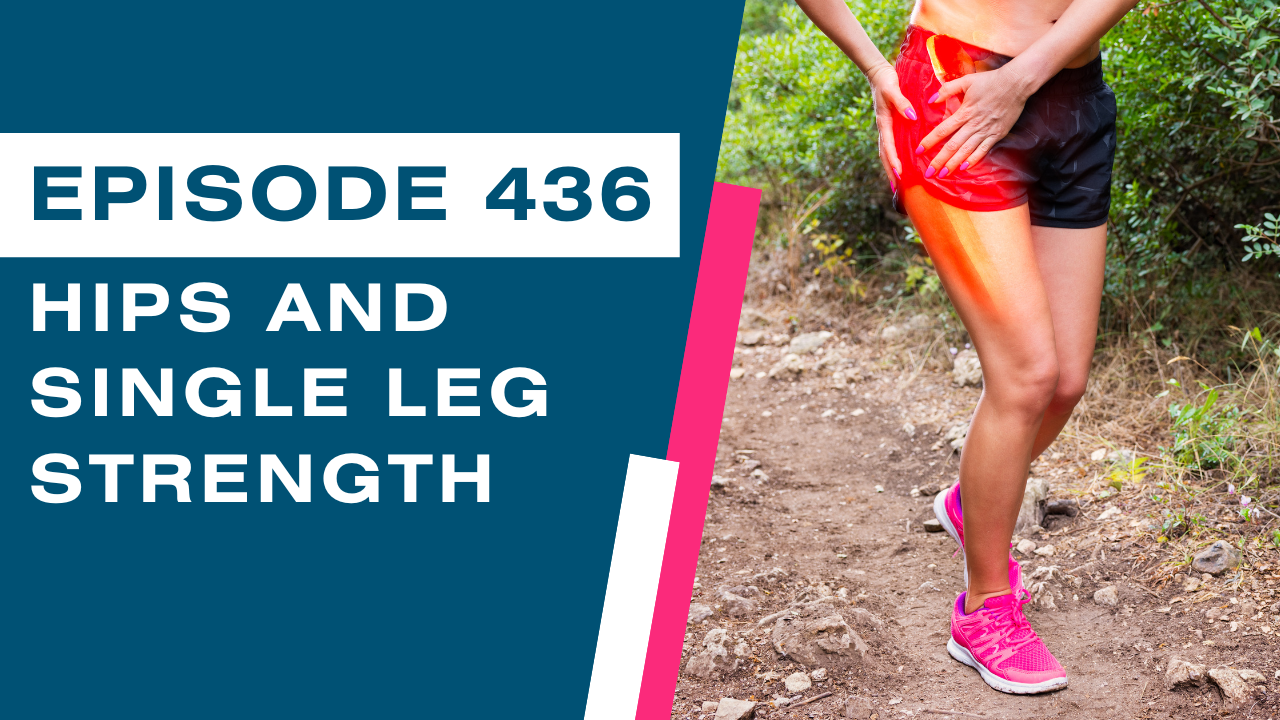
436: Hips and Single Leg Strength
Nov 20, 2025Although most people think of running as a two-legged activity, running is essentially a one-legged sport. Every step you take is a tiny single-leg balance challenge paired with a mini power jump. When your hips aren’t strong enough to handle that load, your body compensates… and that’s where most gait issues and overuse injuries start to show up.
So if you’ve ever wondered why something keeps nagging you, or why your stride just doesn’t feel as smooth or powerful as you’d like, this is for you.
Why Strong Hips Matter So Much
After almost two decades as a physical therapist working with runners, I can confidently say this:
If something looks “off” in your gait, your hips are almost always involved.
We tend to obsess over shoes, foot strike, pronation, gadgets, and gear, but the real power center isn’t down at your feet. It’s your hips and glutes. They:
- keep your pelvis level
- stabilize your knee
- support your foot mechanics
- create forward propulsion
- protect your spine
- absorb massive impact forces
If your hips aren't doing their job, everything below them starts working overtime, and that’s when pain shows up.
Just ask Kevin…
For years, he worked hard and ran fast… but never actually strengthened the right muscles for running.
Then came a series of aches, pains, and some very comedic first attempts at clamshells when I was practicing some of my newfound PT knowledge on him. (If you’ve ever tried clamshells correctly for the first time, you know exactly what I mean.)
He finally realized what so many runners discover:
If your hips aren’t activating well, everything else becomes harder.
Once he learned how to properly fire those glutes and build real hip strength—not just gym strength—his running changed dramatically. Knee pain resolved completely, his stride efficiency went up, and running felt fun again.
Understanding the Mechanics: Why Hip Control is Essential
When you run, you spend nearly the entire gait cycle balanced on one leg while absorbing 2–3x your body weight with every step.
Your hips decide whether your:
- knee collapses inward
- pelvis drops
- foot crashes or rotates
- lower back compensates
- stride feels smooth vs. sloppy
- body absorbs or transmits load
This is why single-leg strength and control aren’t “nice to have”—they’re essential. They reduce your risk for things like:
- IT band syndrome
- runner’s knee
- glute pain
- hamstring overuse
- Achilles flare-ups
- shin splints
It’s all connected.
Simple At-Home Tests to Check Your Hip Control
Want to see how your hips are doing? Try these:
- Single-Leg Sit to Stand – Notice if your pelvis wobbles or your knee collapses inward.
- Single-Leg Squat – Watch your knee tracking, hip level, and torso stability.
- Step Down Test – Great for spotting knee valgus and hip drop.
- Single-Leg Bridge Hold – Helpful for detecting weak glutes and overactive hamstrings.
These are quick, powerful insights into how your body is currently managing load.
How to Build Real Hip Strength (the Runner Way)
Start simple, build consistently, then progress. You don’t need fancy equipment—just good form and intention.
Foundational Strength
- Glute bridges
- Clamshells
- Side-lying hip abduction
- Single-leg deadlifts
Progressions for Power & Control
- Bulgarian split squats
- Step-ups
- Lateral hops
- Single-leg hops
Remember: form > reps. Quality wins every time.
Don’t Forget Mobility
Strength without mobility is like having a powerful engine in a tight, rusted frame—it won’t move well.
Focus on:
- hip flexor mobility
- thoracic rotation
- ankle dorsiflexion
These allow your glutes to fire, your pelvis to stay aligned, and your stride to open up naturally.
Why This Matters Even More After 40
If you’re a runner over 40 (especially women), this becomes even more important. With hormonal shifts and natural decreases in muscle mass and neuromuscular efficiency, we need strength work to protect our joints, maintain power, and keep running feeling good, not heavy and sluggish.
Stronger hips = smoother running + fewer injuries + longer running life.
How to Build This Into Your Routine
Aim for 2–3 focused sessions per week, even just 10–20 minutes at a time. Little bits done consistently will change your running more than you can imagine.
If you want structured guidance, or you’re tired of guessing what to do and hoping it works, our Real Life Runners coaching programs are built to help you understand your body, build strength strategically, run with confidence, and finally break the cycle of injury.
If you’re not sure where to start, check out the 30 Day Running Reset, which gives you the exact runs and strength routines you need to build stronger hips and a smoother, faster stride.
We’ll show you exactly what to do, with progressions that match where you are now.
Get out there and run your life!
Enter your email address to get weekly episodes delivered to your inbox plus tips on how to become a physically and mentally stronger runner!
Don't worry, we won't blow up your inbox. We just want to send you some great info to help you in your running journey. We hate SPAM, and we will never sell your information, for any reason.
